How to sort a lifetime of prints into albums
A method a person with a job can finish: one decision before the first print, a sort that is not a cull, capacity arithmetic, and the memo strip.
The second hour
The first hour feels like progress. You pull a stack of prints from a shoebox, lay them on a kitchen table, and turn them face-up in roughly the order they were developed. The pile on the right is the one you have touched. The pile on the left is the one you have not. The hour ends with the unsorted pile slightly smaller and a feeling that you have started something real.
The second hour is the one that ends the project for most people. By then, you have learned that the left-hand pile does not visibly shrink in the way you expected. You put three prints into a stack and three more appear to have been hiding underneath them. Every print asks a small question. Who is this child. Is this your grandmother or her sister. Is this the trip to the coast or the trip to the lake. Each question takes thirty seconds and answers nothing urgent. The work has the shape of the work. It does not yet have the feeling of progress. You close the box, put it back in the closet, and promise yourself another weekend that never quite arrives.
This is not a failure of willpower. It is a feature of the job. Sorting a lifetime of prints is not a project that rewards momentum. It rewards a method that has been decided in advance, a small set of physical rules that take the questions off the table, and a place for every print to land in the first thirty seconds you look at it. The method takes one Saturday morning, in the order it is set down here.
Before you touch a print, make the one decision
There is exactly one decision that has to be made before any print comes out of the box, and it determines what the rest of the work looks like.
The decision is whether the album is organized by time or by person.
If the prints come from one family, going back through decades, and the goal is a record that a child or a cousin can open and read in order, sort by year. A year-by-year archive is the right answer for most family archives. It is also the right answer for a single person's life: the prints from a parent's house, the prints from your own twenties that turned up in a closet, the prints from a long marriage that ended. The years do the work of organizing the questions for you. You stop asking who is in the photograph and start asking when, which is usually easier to place.
If the prints come from a house with several children, or if the prints are being sorted as gifts for several aunts, sort by person, or by event. A baby book is a person sort. A wedding album is an event sort. A summer at the lake is an event sort. By-person and by-event sorts require more decisions up front, but they produce albums that can be handed over and finished. For most mixed households, the right answer is to do both. One archive, year-by-year, lives on a shelf. Smaller by-person or by-event albums are made from it as gifts, and from the prints that turn up afterward.
There is no third answer. People who try to sort by both at once, weaving time and people together on the same table, end the second hour with a pile and no method.
The first pass is a sort, not a decision
The first time you put your hands into a box of prints, you are not deciding what to keep. You are sorting.
Set up a labelled box, an index card, and a pencil for every decade you can see in the box. One box for the 1960s. One box for the 1970s. If a print is from the early 2000s and you are not sure whether it belongs with the 1990s children or the college years, write the year on the back near the edge with a soft graphite pencil and put it in the box it most likely belongs in. You will move it later if you need to. Movement is fine. Stalling in an unsorted pile is not.
Set up a smaller box called the orphans. Anything nobody in the room can place lands there. The uncle on the porch. The woman in the uniform. The child at a cake with no name on the back. Do not stop sorting to figure them out. The orphans will become smaller as the dated prints leave the unsorted pile, because once the dated prints are out of the way, the undated ones start to fit into the boxes by association. The aunt who appears in every 1974 print is, with high probability, the aunt in the 1973 print with no date on it.
The Library of Congress, the library that cares for the country's largest collection of photographs, handles photographs in working collections this way too: mark only on the back near the edge with a soft graphite pencil, and preferably mark the housing instead. We do the same. Most prints go into a pocket without ever being written on.
The first pass usually takes an afternoon for a single large box and is the only step in this article that scales with the size of the inheritance. Everything after it scales with the number of years you decide to put in albums, which is smaller.
| Pass | What you do | What you do not do |
|---|---|---|
| First: the sort | Years, then events, into labelled boxes; a box for the unplaced | Decide what to keep; read the backs; get lost in 1994 |
| Second: the choice | The keepers per year, counted | Keep the seventh photograph of the same cake |
| Third: the album | Prints in, memo strips written, empty pockets left at the year’s end | Fill the album to the last pocket |
Handling, between the box and the album
Photographs are not fragile in the way a glass is fragile. They are fragile in the way a paperback is fragile. A print that is handled badly for fifty years still looks like a print. A print that is handled well for fifty years looks like a print too. The reason to handle them well is the small cumulative damage, the oils and the bending and the clip mark, that turns a clean photograph into one a careful descendant will not display.
The rules are short.
Clean dry hands. Cotton gloves are not required at home. The Library of Congress recommends clean hands or clean nitrile gloves for handling prints in any context. At a kitchen table, clean and dry is enough. If your hands are at all cold or recently moisturized, wash and dry them again before you pick up the next stack.
By the edges. Hold prints at the corners or the short sides. Avoid the image area. This is not fussy. It is the same rule a framer uses.
No paper clips, no rubber bands, no sticky notes, no tape, no glue. The Library of Congress lists each of these as a thing not to do, and so do we. Paper clips leave an indent and, over years, an outline of rust. Rubber bands leave an indent and, over decades, a yellowing stripe. Sticky notes leave adhesive. Tape leaves adhesive and a color shift. Glue is the one that does not come off. If a stack of prints is held together by anything other than a clean envelope or a folder, take the fastener off before you put the stack in a box.
A soft graphite pencil on the back near the edge, only when a print must be marked. If a print has no date and no one can place it, the back edge is the place for a small, light pencil mark. Do not use a pen. Do not use a marker. Do not write on the front. If the print is already in a pocket-style album with a memo writing area beside each pocket, write on the album page, not on the print.
That is the entire handling kit. The rest of the work is decision-making.
The second pass: keepers and the rest
Once the prints are sorted by year and sitting in labelled boxes, the second pass is the one that decides what goes into an album.
For each year, pull the box and lay the prints on the table in roughly chronological order. Then make three small piles, fast: yes, no, and maybe. Yes is the print that earns its pocket. A person, a place, a moment that means something in plain daylight. No is the duplicate, the blurred frame, the seventh photograph of the same cake, the blown-out flash on a face nobody would recognize. Maybe is a small pile, perhaps ten percent of the box, of prints you can talk yourself into or out of at one glance.
The rules for the no pile are not aesthetic. They are practical. A 300-print pocket album holds one good year for a typical family, not a year plus a backup copy of every cousin's birthday. Duplicates age in pairs and then in stacks, and the second copy is almost never the one that gets put in the album. Blurred frames stay blurred. The seventh shot of the cake is the third or fourth plus three. The best is already in the yes pile.
The maybe pile gets looked at once more before it joins the no pile, because some of the maybes are the best print of the moment and only look uncertain in the first pass. The rest go in the box.
When the second pass is over, each year has a yes pile and a no pile, and the no pile goes into a labelled storage box. Our storage boxes have a small metal identification plate on the front and index cards inside. An index card records what is in the box and what year it covers. The no pile, kept, is the material for a second look in five years and for any print that turns up after the album is already on the shelf.
The arithmetic of how many prints go in
Two numbers decide how many years fit in an album: how many yes-prints each year produced, and how the album is laid out.
A pocket album with 300 pockets holds roughly one year for most families. Big families produce more. Small families produce fewer. Pocket albums come in capacities from 36 prints up to 504 prints, mostly for 4x6 prints, with 5x7 and 8x10 lines for the prints that came back from the lab in those sizes.
The arithmetic the album asks you to do is simple. Count the keepers for each year, choose an album of the right size, and place the year on the spine. Most pocket albums on the shelf will hold a year, two years, or a busy eighteen months. The album that holds four years is the album where a grandparent is no longer in the photographs. The year that produced too many keepers gets its own album, a fatter one, with a year range on the spine.
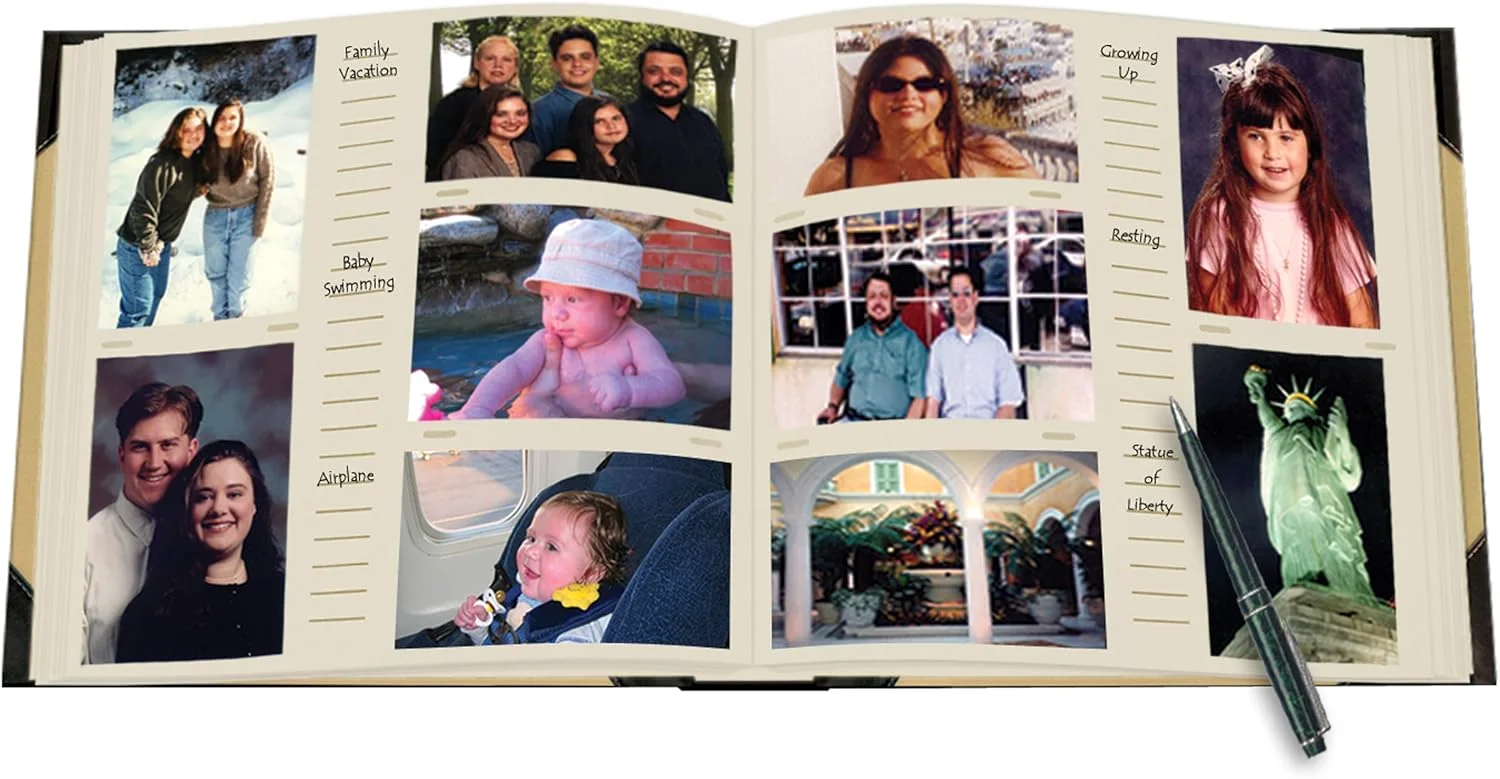
A 500-pocket album with five pockets to a page, three across and two down, holds a year in which there was a lot going on. Two or three prints to a page is the natural tempo for a pocket album. The pocket lines we make hold the print in place without adhesive, so the album stays flat and the prints come out clean if they ever have to. Bi-directional pockets on some lines accept a horizontal or a vertical print in the same pocket, which is the small convenience that makes a mixed-size year easier to lay out. The memo lines have a writing strip beside each pocket.
At the end of every year in an album, leave the last two or three pockets empty. Prints turn up. A relative sends a sleeve in the mail two months after the album is finished. The empty pockets at the end of the year are the place those prints go, without unstapling the spine and without pretending the album is closed.
| Keepers in a year | Album | Why |
|---|---|---|
| Under 150 | 200-pocket memo album | Room for the ones that turn up later |
| 150 to 250 | 300-pocket memo album | The common size for a family year |
| 250 to 450 | 500-pocket album, five to a page | One book for a big year |
| A year with tickets and cards | 12x12 or 8x8 scrapbook, post-bound | The page takes what a pocket cannot |
| A mixed pile from a relative’s drawer | Magnetic self-stick album | Sizes vary; the page does not care |
The memo strip, and what to write
The memo writing area beside each pocket is the reason a printed album is more useful than a stack in a box. A photograph of a child at a table, on its own, is a question. A photograph of a child at a table, with a handwritten note beside it that says "Greta, age four, the morning she learned to whistle," is the family.
Write a short note for each print, or for each pocket if two prints share one. The note has three fields: date, place, and who. Most of the time the date is the year, and the year is already on the album spine. The field on the strip is for the month and the day if you know them. The place is the city, the street if it matters, the room if it is at home. The who is the names of the people in the photograph, spelled the way the family spells them.
The hardest notes are the ones for people nobody in the next generation will recognize. Write the relationship, not just the name, on the strip. "Uncle Joe, dad's brother, the tall one." "Mrs. Patterson, lived next door, 1962 to 1979." The job of the memo strip is to keep a future reader from having to do the work the current generation has already done.
Use a soft graphite pencil, or an acid-free gel pen. Both are sold for albums. Do not use a ballpoint. Do not use a felt-tip. Either of those will, over time, ghost through a clear pocket onto the print beside it.
Memo albums in our range
Three pocket albums with a memo strip beside each pocket: the place for the date and the name.
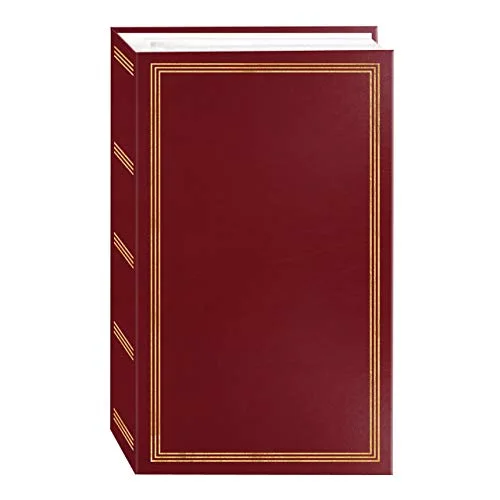
3-Ring Pocket Photo Album, 504 pockets
Burgundy Red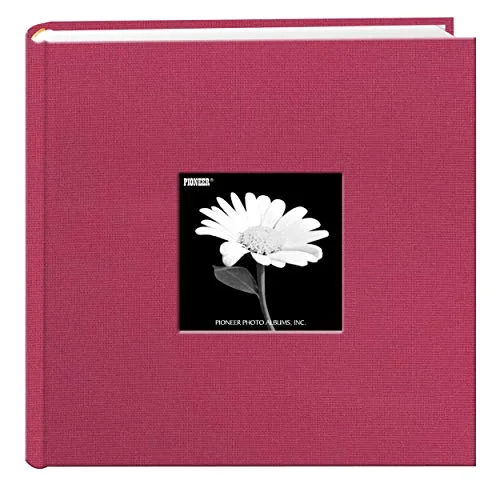
Fabric Frame Cover Photo Album, 200 pockets
Bright Pink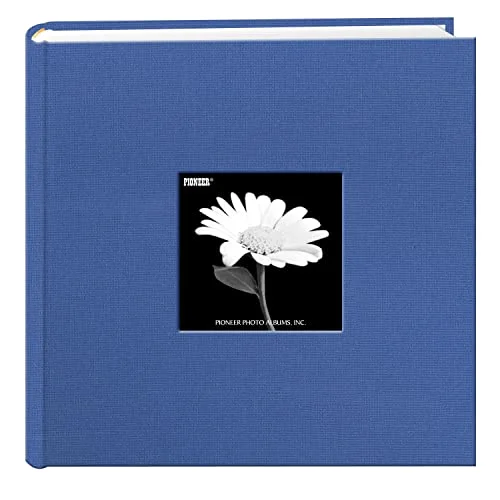
Fabric Frame Cover Photo Album, 200 pockets
Sky BlueWhen to make a scrapbook instead
Some years are not a print sort. They are a paper sort, and the album for them is a scrapbook.
A year that produced tickets, programs, church bulletins, a child's drawings, the menus from a wedding, the cards from a milestone birthday is a scrapbook year. The prints go into pockets on top-loading page protectors. The ephemera goes on the heavy insert that slides out of the protector while the protector itself stays on the post or the ring. A scrapbook is also the right answer for a wedding, in detail. For a school run, two years of one child in kindergarten through second grade. For a long trip. And for any year that ends with a stack of papers and a small drawer of memories.
Scrapbooks come in 12x12, 8x8, and 8.5x11 page sizes, with post-bound and 3-ring spines that take refills. Most of the work happens after the album is bought. The album is the container that holds the inserts and the protectors for as long as the family wants to keep adding pages.
Pocket albums and scrapbooks do not compete. A scrapbook sits next to the pocket albums on the shelf and covers the years the pocket album cannot. The two kinds, side by side, are the shape of a household that has finished the work.
When a magnetic album is the right call
Magnetic self-stick albums were a popular answer to a real problem: a drawer of prints in mixed sizes from a relative's house, with no time to sort them into pockets. The clear plastic overlay lifts, the print goes down, the overlay comes back, and the print is held without a pocket or a corner. A magnetic album takes 4x6, 5x7, 8x10, and wallet prints on the same page, without the layout work a mixed pocket album would ask for.
The honest limit of a magnetic album is that the adhesive is on the page, and the print is the thing in contact with the adhesive. The National Archives recommends avoiding magnetic albums with self-stick adhesive for long-term storage of photographs. The magnetic albums Pioneer makes are useful for prints that will be looked at, passed around, and replaced. They are not the right answer for prints a person wants to keep for fifty years.
The right call for a magnetic album is the relative's drawer. Sort the drawer fast, by size if not by year, into a magnetic album so the prints are no longer loose, and plan to scan or reprint the keepers within a few years. A magnetic album is a holding pattern, not a destination.
Negatives, slides, and the digital copy
There are three more things in the box that are not prints. They need their own handling.
Negatives go somewhere else. The Library of Congress recommends keeping negatives separate from prints, and so do we. Negatives in the same envelope as the prints scratch the prints. Negatives in the same bag as the prints become impossible to find when a print is lost. File the negatives by the same year labels, in paper sleeves, in a photo storage box, on a different shelf from the prints.
Slides get the same treatment. If the family has a slide projector in a closet, the slides probably belong to whoever owns the projector after the estate is sorted. If not, they go in a labelled storage box with the negatives.
The digital copy is the third item. Scan the keepers, not everything. A flatbed scanner at 600 dpi produces a file that is good enough for a phone, an email, a printed re-order years later. Keep the print anyway. The print is the original. The scan is the backup.
Putting prints into albums is one job. The digital copy does a different one: it lets a print be lost without the moment being lost. A scanned keeper can be reprinted. A scanned moment that was never printed is only a file. Put the keepers in the album, and scan the keepers, in that order.
The shelf, and the Sunday hour
When the project is finished, the shelf is the answer.
A row of pocket albums, one or two per year, spines labelled with the year in handwriting large enough to read at arm's length. A smaller row of scrapbooks for the years that needed them. A storage box, with the metal plate on the front reading its contents, holding the no pile and the prints that came in after the album was finished. The National Archives recommends boxes large enough for the originals to lie flat without folding. Both the Library of Congress and the National Archives recommend storing photographs in a relatively dry, cool, stable place. That means an interior closet, not a damp basement, a hot attic, or an unheated garage. The shelf is the household version of a small archive.
A family that has done this once does not do it again.
The habit that keeps the shelf up is not a project. It is an hour on a Sunday afternoon, four times a year, at the kitchen table. Pull the prints that have come in since the last hour. Sort them by year. Place them in the empty pockets at the end of the years they belong to. Write the note on the memo strip. Put the album back on the shelf.
The box is where the sorting happens. The album is where it ends.
This is the part of the work that does not change. It is the part Pioneer has been doing, in one form or another, since 1972: albums get built, prints get placed, and a family keeps a record of itself that does not depend on a charger or a cloud account or a working hard drive. The shelf, the albums on it, and the habit of a Sunday hour are the whole method, kept up over a decade.